What is a progression or progressive run?
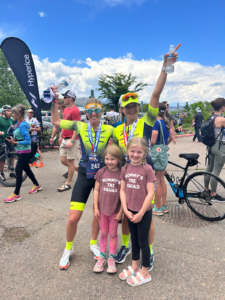
The easiest way to to understand a progression run is: it’s a training run where you gradually work on getting faster and faster; Starting comfortably (easy), then increasing your pace to an uncomfortable faster level. It’s similar to what swimmers refer to as descend pace or negative split training. Same concept.
Running negative splits isn’t about simply sprinting at the end of a run, it’s about:
- Understanding your body’s effort levels
- Practicing pace discipline
- Building the ability to increase pace when fatigue sets in
By training your mind to hold back when your body feels good and push when the race gets tough – which happens most of the time in those last miles of a triathlon – you can transform your run performance.
Not as taxing as hard interval or tempo runs
Starting easy helps your body warm up and allows you to increase your volume of run training overall. Your ability to run strong late depends on your aerobic base, mental strength and leg durability. Progression runs are great lower risk way to add faster running after injury a break or when just learning variable, productive pacing (where you change paces on purpose, not just because you can’t hold your pace). They build endurance and boost fitness without a lengthy recovery time. It’s also a way of learning to keep the easy efforts easy and avoiding running hard all the time (becoming a one pace runner).
Mental challenge
The mental challenge comes in teaching yourself not to go out too hard. It feels easy to go out harder because in the beginning, the run doesn’t feel hard. But in the end, it comes back to haunt you as we more often than not slow down through a race or hard workout.
Pace discipline
Learning how to pace yourself in any of the three disciplines is challenging and can take some time. But, it’s especially challenging in the triathlon run. In training, it’s important to work on your goal pacing and variable pacing. Does your body know the difference between a 10 minute, 9 minute, 7 minute and 5 minute mile effort feel like? Do you have a specific marathon time goal? Are you training at or near that pace? It’s critical to learn both the mental and physical aspects of training at variable paces and how to finish strong.
Importance of a strong finish
Do you start your interval or tempo sessions strong and then progressively fade through the workout? Or does your Ironman marathon start out strong and steady only to end with a foot dragging walk? Although true for so many of us, this shows a lack of pace discipline in training and possibly a lack of volume and frequency of run training specifically. Just think of how much faster you could run with a strong finish. You can learn how to run the second half faster than the first. Train this and you can!
How and when to do progression runs –
They can be done mostly year round and become more specific as you get closer to your race season. To measure intensity, use RPE, speed, power, challenging terrain, etc. And, remember to use it for goal race pace simulation.
-If you’re new to running progressively, start with a shorter run of 3-4 miles.
-You can work more on running by feel by using RPE (rating of perceived exertion); check in with your watch to see how you’re managing.
-You can try any distance run and run 75-90% at a steady easy pace, then for the final 15-25 % gradually pick up the pace
-Super fast finish: running super fast to simulate fast closing miles or sprint finish.
– You can start progression runs at the end of your base phase, starting with once per week. Depending on your experience level, this can increase up to 3-4x/week, up to and including your long run.
Sample progression run and bike+run workouts
These runs can be structured (specific distances or time intervals throughout the run) or general (just getting faster).
- Break your run into thirds: first third easy, second third moderate, third section fast.
- Very fast finish: any length run, finish very hard and fast the last 2-8 minutes.
- Increase your pace by ten seconds/mile for a certain number of miles.
- Build your long run into a marathon pace finish to train your goal marathon pace effort
- Go faster with each mile
- Go progressively faster every 5-10 minutes for 20-45 minutes
- Negative split your run off the bike. After your ride, get off and run an easier first mile and fast 2nd mile OR get progressively faster every 5 minutes for 20-30 minutes.
Training to run negative splits in triathlon is a learned skill that combines:
Controlled pacing in workouts, running off the bike with purpose, learning run pace discipline and confidence that builds through training. It doesn’t happen overnight, but if you train this way consistently, you’ll feel stronger, race stronger and smarter and finish faster.